

Government agencies are beating financial services at AI ROI by two to three times. Small companies are outperforming large enterprises by half a point on a five-point scale. These findings are based on the AI ROI Benchmarking Study 2025 by AIDB Research, which analyzed 5,124 AI use cases reported by 1,245 practitioners across industries. The divide comes down to work complexity.
AI delivers higher returns when applied to tasks measured in hours or days and evaluated by domain experts. When confined to low-complexity work measured in minutes, returns plateau fast.
Work Complexity Predicts Returns
Government leads the rankings. Education follows, then media. Financial services and healthcare land in the bottom half despite massive AI investments. The gap shows up in how AI gets applied. Government agencies use it for policy analysis. Education deploys it for curriculum development. Media organizations apply it to content creation. These are tasks that take days or weeks and require judgment, synthesis, and context.
Financial services focuses on compliance checks. Healthcare prioritizes data validation and quick lookups. Fast, bounded tasks where gains are measured in minutes. AI ROI correlates with work complexity, not technical sophistication.
Small Companies vs. Large Enterprises
Small companies report average ROI of 3.49. Large enterprises report 2.94. The difference shows up in organizational distance. At small companies, the person who knows what "good" looks like is often the person using the AI. Feedback happens immediately. Errors get caught in real time. Iteration is continuous. Large enterprises separate evaluation from execution.
Feedback cycles stretch from minutes into weeks. Value leaks during handoffs, rework, and escalation.
Time Savings Don't Compound
Seventy-seven percent of organizations cite time savings as their primary benefit. They report lower overall ROI than organizations pursuing strategic benefits. Improved decision-making lifts ROI by 0.20. New capabilities lift it by 0.21. Time savings alone shows minimal correlation. Ethan Mollick at Wharton explains why. A task that takes one hour and requires thirty minutes to verify only pays off if AI succeeds on the first attempt.
A task that takes seven hours supports multiple iterations and still wins. Organizations saving fifteen minutes on emails get fifteen minutes. Organizations delegating work measured in hours or days change throughput. Efficiency gains only compound when workflows absorb iteration without escalation.
Management Capability Determines Success
Mollick taught executive MBA students to build working prototypes in four days using AI. Doctors, managers, business leaders. They succeeded because they already understood delegation: how to scope work, define deliverables, evaluate quality, and decide when something moves forward. Inside AI labs, developers spend less time writing code and more time managing AI agents.
Specifying intent. Evaluating outputs. Providing feedback. Strong subject matter expertise and clear evaluation frameworks predict success. Technical capability alone does not.
The Pattern
Eighty-two percent of organizations report positive AI ROI today. Ninety-six percent expect it within twelve months. Nearly everyone sees value. Some see 3.49. Others see 2.94. Organizations that delegate complex work, evaluate fast, and iterate based on expertise capture disproportionate value. Organizations treating AI as a faster typewriter get exactly that.
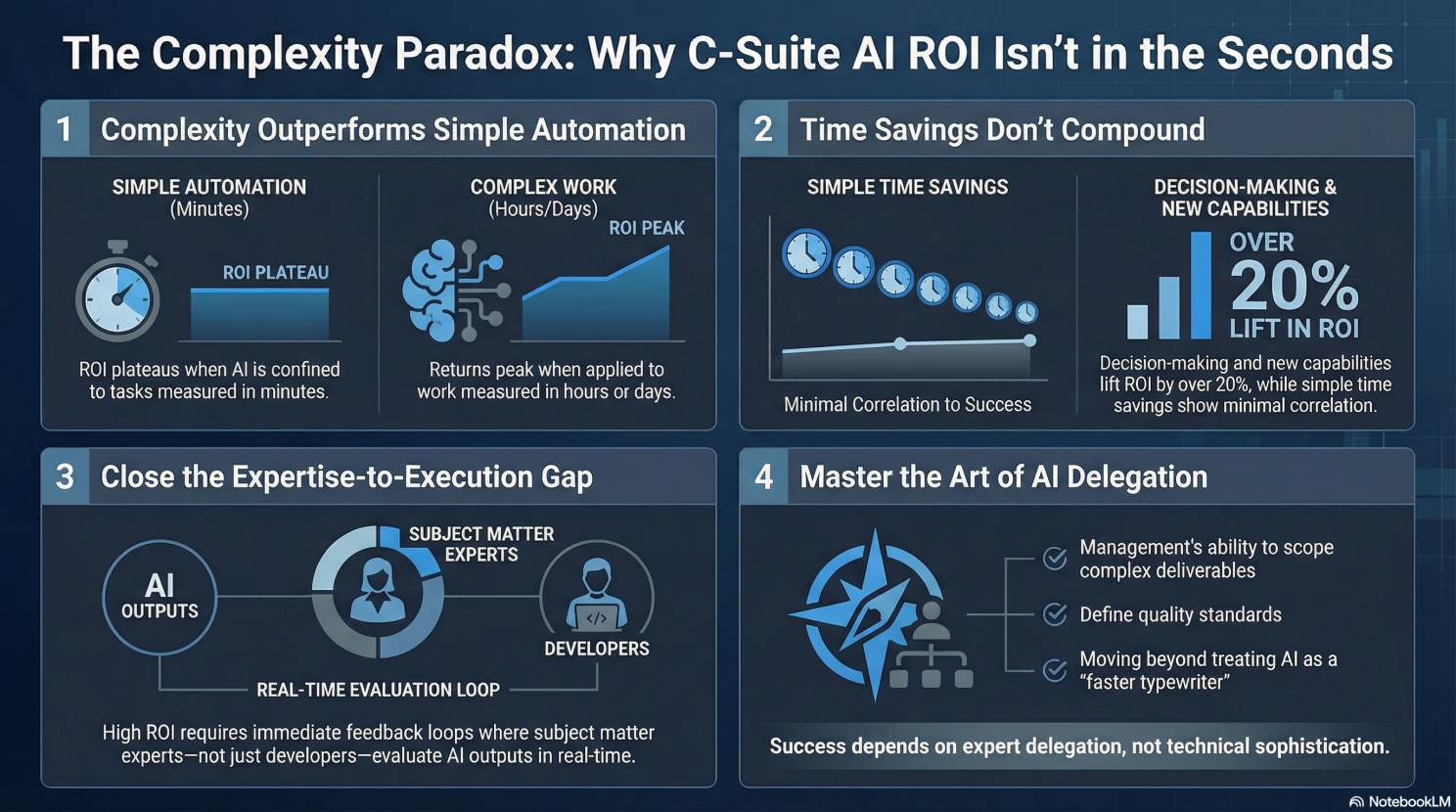
The gap comes from delegation capability. Clear goals. Fast feedback. Expertise close to execution. Efficiency gains are real. Advantage compounds somewhere else. Most enterprises know how to buy AI. Fewer know how to delegate to it. If your organization is generating activity without throughput, reach out if you need help.