

The first agent failure may not look like an agent failure at all. It may look like a service restart, a latency spike, or an unexpected cost increase. The incident gets logged. The system gets restored. The postmortem names the API, the workflow, and the team that fixed the issue. The agent that set the chain in motion barely appears. Gartner put a number on that risk this week.
By 2027, 40% of enterprises will demote or decommission autonomous AI agents because governance gaps are being discovered only after production incidents occur. The underlying failure is ownership. Agents are being deployed into workflows where they can act, trigger systems, and create downstream consequences before organizations have answered a basic question: who is accountable for what this agent does?
The question sounds straightforward until an agent is operating across systems, consuming data from multiple sources, generating outputs for different teams, and taking action inside processes no single function fully owns. With traditional AI tools, a human usually stays close to the final action. Someone reviews an output, edits the draft, or decides whether to use the result.
Agents change that pattern. They execute. They call systems. They initiate workflows. The distance between human judgment and system action is getting longer. Accountability starts to blur in that distance. Ownership has layers. Each one depends on the one below it. With agents in production, all three are urgent.
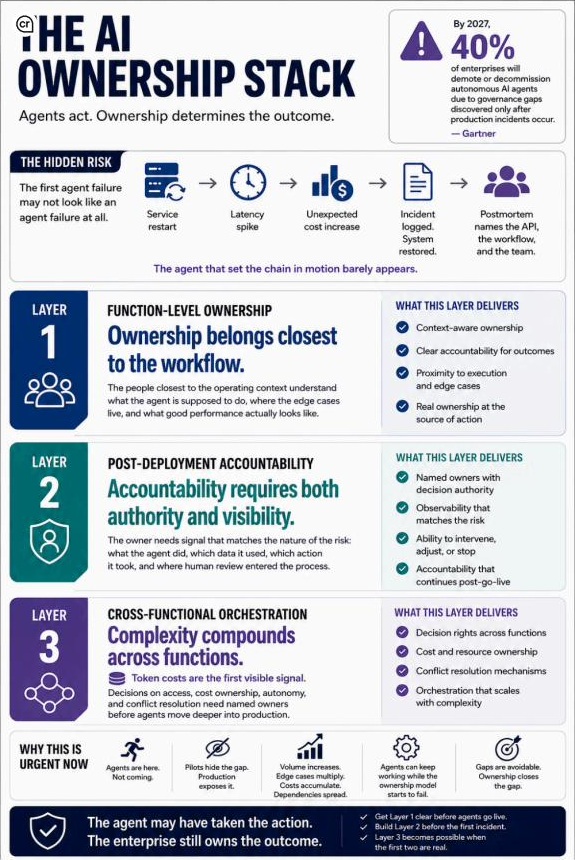
Layer 1: Function-Level Ownership
Ownership belongs closest to the workflow. The people closest to the operating context understand what the agent is supposed to do, where the edge cases live, and what good performance actually looks like. With agents, the stakes of getting this wrong are higher. A static AI system surfaces an answer. An agent takes an action. It can route an issue, update a record, or initiate a process.
The distance between a nominal owner and the actual workflow is the distance between accountability and exposure. The right owner needs to be close enough to evaluate what the agent is actually doing. Close enough to recognize when the agent is technically working while producing the wrong business result. A central AI team can provide standards, platforms, and governance.
It cannot own every business process where an agent acts. The function has to own the use case because the function understands the context the agent is operating inside. Before an agent goes live, each function needs to answer: Where exactly does this agent operate in our workflows? Who is responsible for its outputs? Who is accountable when it behaves correctly by design but creates the wrong business outcome?
The org chart will not reveal the right owner. The workflow will. Without this layer, everything above it is theoretical.
Layer 2: Post-Deployment Accountability
Planning-stage ownership is one conversation. Post-production is a different one entirely. When agents are live, questions multiply fast. Who has authority to act when the system underperforms? What happens when costs climb unexpectedly? Who decides when the system needs to change? Getting AI into production gets planned. Post-deployment accountability gets designed last, if at all.
This layer requires named owners, not committees. Accountability requires both authority and visibility. The owner needs to know when intervention is required, and needs the authority to act on it. Agents make this layer significantly harder. Standard monitoring tracks whether a call completed. It does not track whether the agent reasoned correctly. A system can produce a clean response while relying on weak context.
It can operate within permissions while exposing a process gap. Standard logs will not catch the difference. The owner needs signal that matches the nature of the risk: what the agent did, which data it used, which action it took, and where human review entered the process. Without that observability infrastructure, the owner has responsibility without the information to exercise it.
In organizations that build agents without building the accountability layer alongside them, that is the default condition.
Layer 3: Cross-Functional Orchestration
Complexity compounds fastest across functions. Token budgets are one early warning sign. Token costs were not a budget line a year ago. They are now. Organizations that deployed agents without clear ownership of resource allocation are discovering this the hard way: costs climbing across functions, no named owner for the resource, no one authorized to address the gap.
The finance signal is exposing the ownership problem. When agents interact across functions without clear decision rights, cost exposure is only part of what becomes invisible. Outputs conflict. Processes break in ways no single function can see. No one knows who is authorized to step in until something forces the question. Investment cycles favor build over operate.
The deployment gets resourced. The accountability infrastructure does not. With agents, that imbalance is harder to detect and faster to spread. Cross-functional orchestration defines how decisions get made when agents cross systems, functions, and budgets. Access decisions, cost ownership, autonomy approvals, and conflict resolution across workflows all need named owners before agents move deeper into production.
This layer only works if the first two are solid. You cannot orchestrate across functions when ownership is vague inside them.
Why This Is Urgent Now
Agents are not coming. They are here. The organizations moving fastest on deployment are not moving at the same speed on ownership. Pilots often hide the gap. Production exposes it. Volume increases. Edge cases multiply. Costs accumulate. Dependencies spread. An agent can keep working from a technical standpoint while the ownership model around it starts to fail.
Gartner's 40% decommission prediction points to gaps enterprises can address before agents reach production. Get Layer 1 clear before agents go live. Build Layer 2 before the first incident. When both are real, Layer 3 becomes possible. The agent may have taken the action. The enterprise still owns the outcome. If your organization is deploying agents and the ownership conversation has not happened yet, reach out.