

Boards have stopped asking whether organizations are adopting AI. They are asking why speed has not translated into results. That is the right question. The uncomfortable answer is that speed and capability are not the same thing. Organizations that treat them as equivalent are building one while assuming the other will follow.
Where the Gap Opens
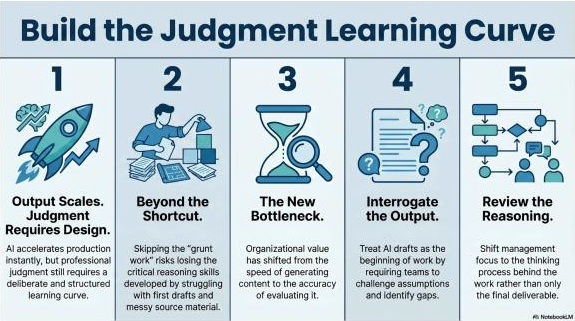
AI is changing junior work first because junior work is full of tasks that AI handles well: drafting, summarizing, researching, comparing, formatting. Output gets done faster. It looks better earlier. Productivity metrics improve. The problem is that much of that work was never just output. It was how people learned to think. Junior employees learn by handling the slow version: reading messy source material, struggling through first drafts, getting corrected, watching senior colleagues challenge assumptions in real time.
They learn which details matter because they have to handle the details themselves. AI compresses that process. The employee feels more productive. What does not automatically follow is the ability to evaluate what was produced. As AI handles more of the production layer, the value of human judgment rises. A technically correct output can still be the wrong answer for the decision at hand.
Production speed can increase before judgment matures. This is why the issue shows up as an ROI problem. The organization is producing more drafts, summaries, analyses, and recommendations, but the quality of decisions does not improve at the same pace. The bottleneck has moved from production to evaluation.
The Developmental Value of Grunt Work
Some junior work is genuinely low-value. Nobody needs to romanticize copying numbers between systems at midnight. But some of it carries developmental value that organizations are now at risk of eliminating. Schools still teach children to do math that a calculator handles in a second. The point is not the arithmetic. It's building the reasoning that lets you know whether the answer is right.
When a junior analyst builds the first version of an analysis, they learn how the pieces fit together. A junior marketer who rewrites a rough draft five times learns the difference between polished language and a real point of view. Synthesizing customer feedback manually develops the instinct to separate meaningful patterns from noise. The work is inefficient.
It is also instructive. AI changes the economics of that learning. It can generate the first pass before the employee has built the instincts that make the first pass meaningful. It can produce recommendations before they have learned to reason through tradeoffs.
Building Judgment Takes More Than Tool Training
Teaching people to produce better AI output does not automatically teach them to evaluate whether the output is any good. The market summary may be accurate. The risk memo may be well written. Neither one helps if the employee cannot identify what is missing, what assumption is weak, or what tradeoff a senior leader needs to see. Those thinking skills develop through deliberate exposure to the gap between what AI produces and what good actually looks like.
What Builds Judgment at Scale
The better path is to make AI output the beginning of the work, then require employees to examine, challenge, and improve it. That means asking junior employees to account for their process: what AI gave them first, what they changed, what they rejected, what assumptions they tested, and where they still feel uncertain. It means shifting manager review conversations from evaluating the deliverable to exposing the reasoning behind it.
That discipline turns AI into a learning environment instead of a shortcut. Organizations that design this deliberately build employees who can work with AI, challenge it, shape it, and use it to extend their judgment. Without that design, polished work moves faster than the employee's ability to question it, defend it, or improve it under pressure.
The Question That Matters Now
Boards are right to press on results. The more precise question for leaders is whether faster output reflects stronger capability or only faster production. Two years from now, the gap between production speed and decision quality will be visible in results. The organizations closing that gap now are treating AI adoption as a capability design challenge, with judgment built into how work is reviewed, coached, measured, and improved.
This is one of the design problems I work on with enterprise teams. If it is on your agenda, reach out.